


Chinese Journal of Philosophy
The Chinese Journal of Philosophy is an open-access general philosophy journal that publishes work in all areas of philosophy, with a special focus on philosophical research that has the potential to make different traditions of thought more fruitful for one another.
The journal aims to represent the multitude of topics and approaches that may fall under the heading of ‘philosophy’ in the world today. The journal therefore invites submissions from anyone working in philosophy and on all philosophical topics including the history of philosophy as well as interdisciplinary research with a substantive component in philosophy.
All articles are published open access, at no cost to authors, by Oxford University Press on behalf of the Department of Philosophy and Religious Studies at Peking University.
The first articles will be published in 2027 at the following address: https://academic.oup.com/cjp [the site is planned to go live in November 2026].
Historical background
The Chinese Journal of Philosophy was created by members of the Department of Philosophy and Religious Studies at Peking University as a timely addition to the international landscape of broad-scope English-language journals in philosophy, alongside titles such as the American Philosophical Quarterly, Asian Journal of Philosophy, Australasian Journal of Philosophy, Canadian Journal of Philosophy, and European Journal of Philosophy. Like these other journals, the Chinese Journal of Philosophy originates in a particular region whilst editing and publishing as an international collective, operating in English, and promoting work from around the world.
Editorial board
Editors-in-chief
Ames, Roger (Peking University)
CHENG Wei (Peking University)
De Warren, Nicolas (Penn State University)
Sunday Grève, Sebastian (Peking University)
ZHAO You (Peking University)
Managing editor
ZHAN Yiwen (Peking University)
Associate editors
An international team of associate editors will be announced in due course.
Advisory board
Beaney, Michael (University of Aberdeen)
Betzler, Monika (Ludwig Maximilian University of Munich)
LIU Chuang (Fudan University)
LIU Xiaoli (Renmin University of China)
Longuenesse, Béatrice (New York University)
Price, Huw (University of Cambridge)
Moran, Dermot (Boston College)
Sher, Gila (University of California, San Diego)
Williamson, Timothy (University of Oxford)
YAO Zhihua (Chinese University of Hong Kong)
[More members to be announced]
Founding committee
CHENG Lesong (Peking University)
LIU Zhe (Peking University)
Sunday Grève, Sebastian (Peking University)
WANG Yanjing (Peking University)
Contact
cjphil@pku.edu.cn
Notes for authors and referees
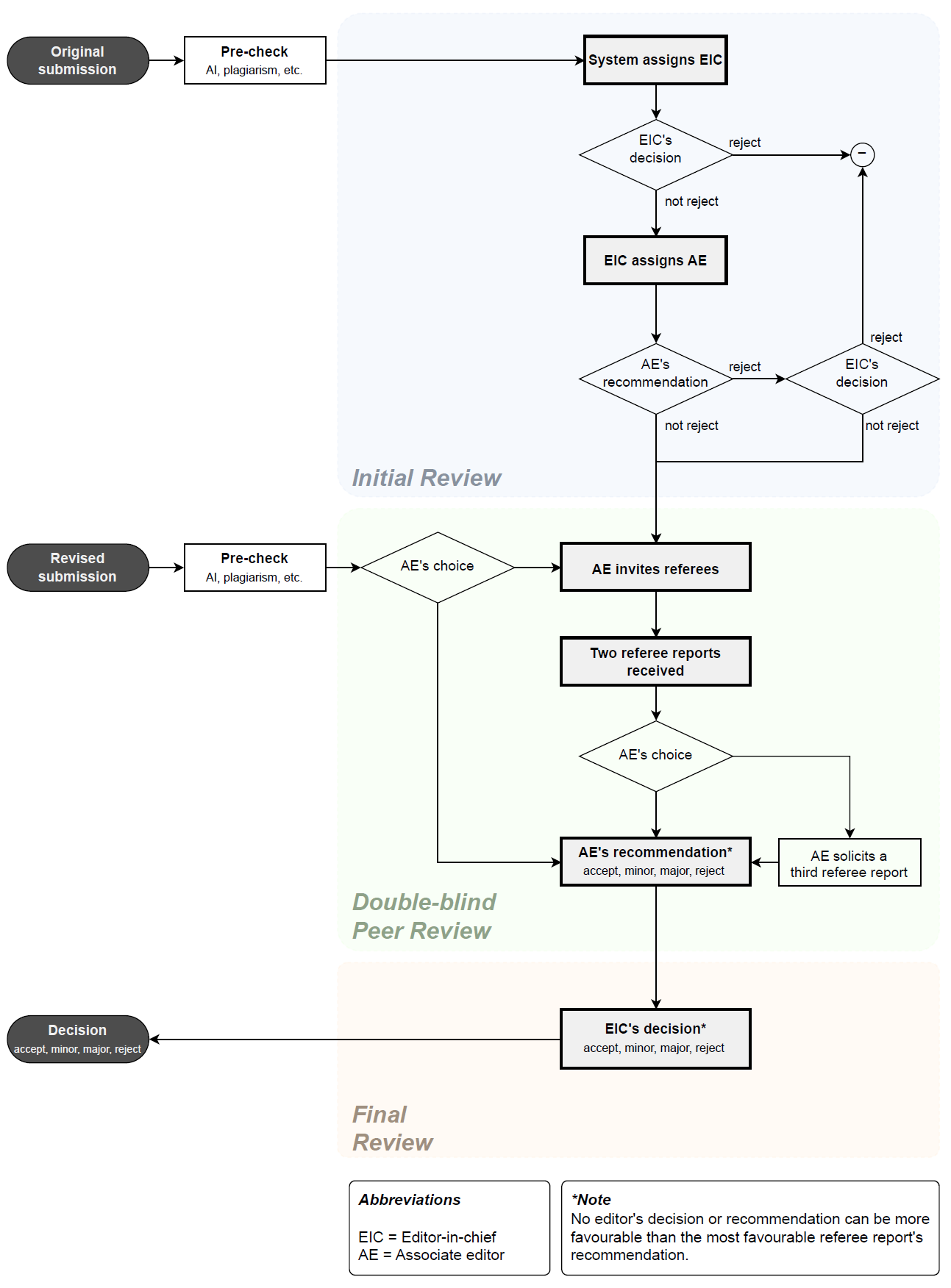
(1) All submissions that pass the initial review will undergo double-blind peer review, as outlined in the flowchart below.
(2) Accepted articles will be published immediately once the production process is finished, complete with article and page numbers.
(3) Current editors-in-chief or managing editors are not permitted to submit their work to the journal or to publish any authored article in it except editorials. Both current associate editors and current advisory board members can submit their work to the journal and publish authored articles in it. Submitted work by an associate editor will in no way be handled by them as an editor.
Author guidelines
(4) The journal accepts electronic submissions only.
(5) Submission of a manuscript is understood to imply that the paper is the original work by the author and has not already been published as a whole or in substantial part elsewhere.
(6) Submissions should include an abstract of up to 150 words and 5 to 8 keywords. These things must be included at the top in the manuscript file. Revised submissions should, in addition, contain an author’s response at the top in the manuscript file and mark all changes to the manuscript as compared with the original submission.
(7) The preferred total length of submitted manuscripts is between 5,000 and 8,000 words, excluding notes and references.
(8) The content should be accessible to readers with a general philosophical background.
(9) Only footnotes, no endnotes, can be used. There should be few, and these should be brief, respecting subfield specific requirements; for example, it is understood that historical scholarship often requires fairly extensive notes.
(10) A list of references, including all and only those works that are cited in the article, must be included at the bottom in the manuscript file. Apart from this, authors are free to use their preferred reference and citation style when submitting their work for review. Accepted articles must follow journal style, before they can be published.
(11) Manuscripts should be submitted in a form suitable for anonymous refereeing.
Referee guidelines
(12) The journal aims to cultivate peer review as a collective effort at improving submitted articles, regardless of whether they will ultimately be accepted for publication in the journal, thus adhering to—and ideally setting new standards for—international best practices of double-blind peer review of research articles in philosophy.
(13) For each original submission that enters peer review, multiple referees are invited simultaneously. Referees are initially given a relatively short deadline to complete their reviews; this is kindly explained as an effort to provide authors with a fast turnaround. Referees are welcome to suggest a longer timeframe for submitting their reports.
(14) It will sometimes occur that more than two referees agree to submit a report on time, although two reports are sufficient for the journal to reach a decision. Consequently, some referees may be informed that their reports are no longer needed. If it becomes necessary to notify a referee that their report is no longer required, they will be given three days to respond. In most cases, either the referee has not yet begun their work, or their report may still be used.